


Art for Justice – Youth reimagine the justice system

On October 22, OJEN welcomed guests to the Wildseed Centre for Art and Activism for an exhibition showcasing artwork created by youth who participated in OJEN’s Art for Justice program.
The program, held over the summer, brought together youth, artists, legal professionals and community organizers to explore ideas about law, justice, community, and social change through art.
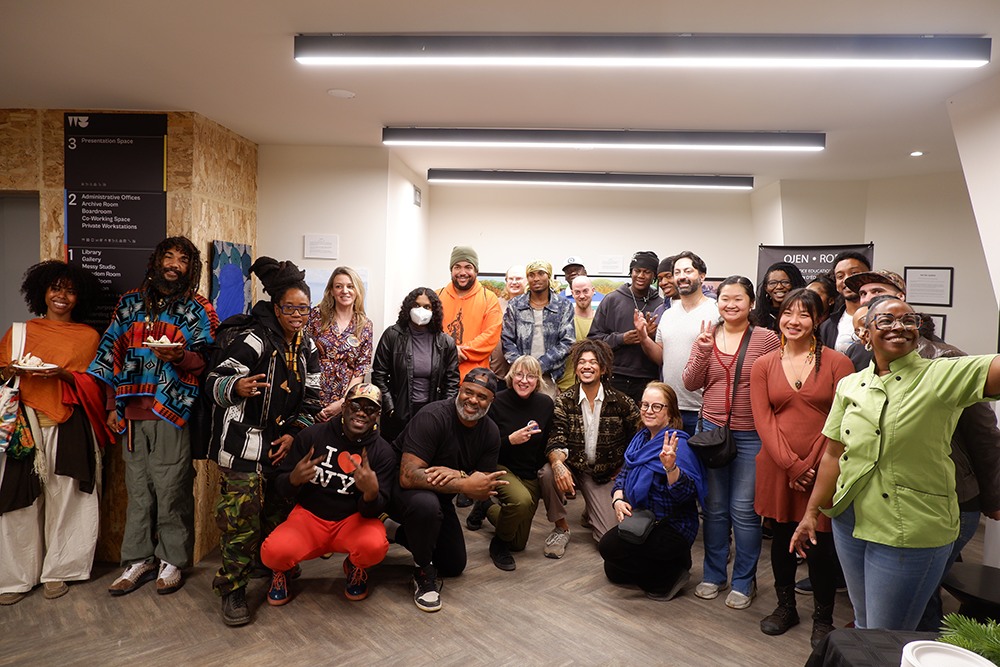
First offered in the summer of 2025, with funding from the Law Commission of Canada and the Law Foundation of Ontario, the program was developed in collaboration with Downtown Legal Services and the Law in Action Within Schools (LAWS) program. Building on the success of its first year, Art for Justice returned in summer 2026 with new community partners: the Black Legal Action Centre, Kensington-Bellwoods Community Legal Services, and the Wildseed Centre for Art and Activism. This year’s program was funded by The Law Foundation of Ontario, with LAWS once again connecting us with participating students.
Over four days, participants developed legal life skills, explored questions about law and justice, and shared their visions for a more just future. Lawyers and community organizers shared their experiences using law as a tool for social change, discussing the connections between law and activism, and the importance of access to justice.
With “reimagining justice” as a starting point, participants developed ideas for artwork that expressed their vision for a more just and inclusive justice system.
International Toronto based artist, Andre Mandela Lopez, led participants through the process of turning their ideas from concepts to finished art, inviting them to express their own feelings and insights about complex legal concepts visually through painting, sculpture, and poetry. The completed pieces were mounted and displayed as a public gallery exhibition at Wildseed Centre for Art and Activism.
Art and law may seem like very different disciplines, but Andre sees creativity as an important part of learning about justice. He explains that art encourages youth to think critically not only about how the legal system works, but also about how it could be different.
“Art is a creative process. Often in education you’re just absorbing facts and regurgitating facts without the critical analysis part, without the creative part. Using art as part of this education is crucial because we’re not only learning about what the legal system is, but we’re thinking about how it should be. We have to be in the creative mode in order to do that. So that’s where art comes in.”
Program developer and PLE consultant, Nat Jaczek, highlights the value of participatory approaches to legal education.
“Young people bring new perspectives and their own lived experience with the law into the classroom, or in this case, the art studio. Through dialogue, OJEN facilitators and the participating lawyers aren’t just teaching about the law, they are learning too. Art for Justice gives youth the opportunity to take an active role in learning about law and justice through discussion, collaboration, and creative expression. By participating in the process, youth can share their perspectives, learn from one another and engage with legal concepts in a meaningful way. The program demonstrates how participatory approaches can complement traditional methods of legal education. In this way, art makes law accessible.”
Enisoné Kadiri, OJEN’s Director of Outreach Programs, highlights the importance of youth voice.
“Through art, youth express their perspectives, share their experiences and imagine a more just and inclusive legal system.”
Kassandra Thompson, OJEN’s Program Manager, emphasizes practical learning.
“Through Art for Justice, youth explore how law affects their lives, build legal life skills and consider how they can create positive change in their communities.”
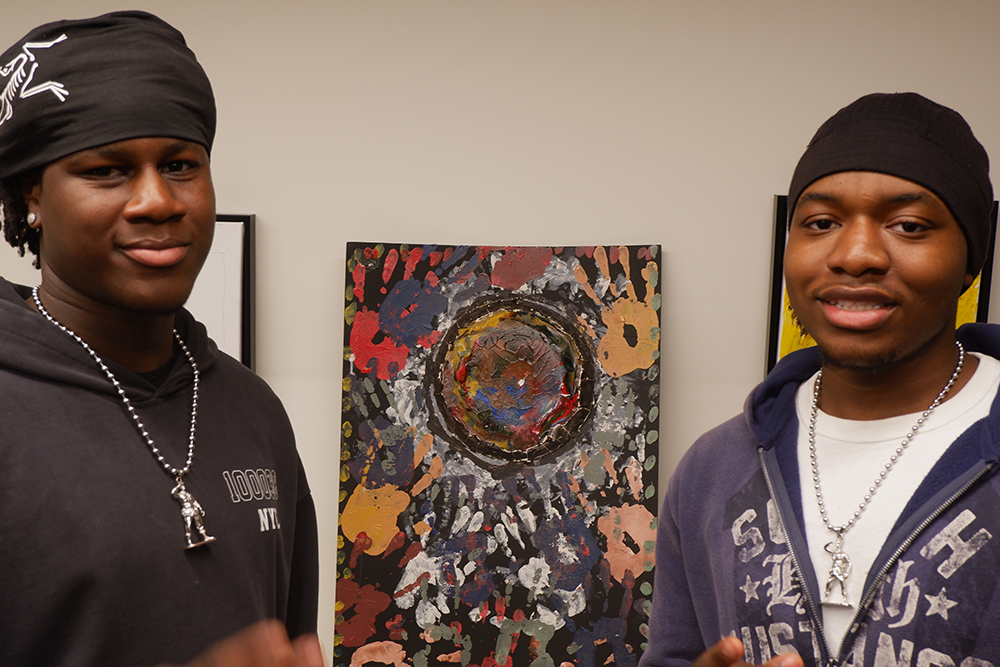
Imprints of Us – by Emmanuel Omotayo & Precious Laya, 2026
Imprints of Us represents our vision of justice—a world where everyone belongs. The hands represent different people, cultures, identities, and stories, while the colours coming together at the centre show the beauty of our differences.
To us, justice means being seen, heard, and included.
Many hands. Many stories. One world shaped by us all.
Medium: Mixed media on card.
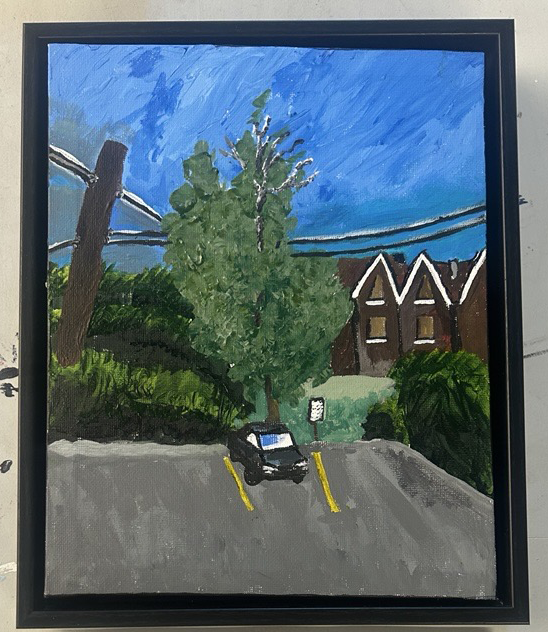
The Living Tree – by Nat Jaczek, 2026
In colonial constitutional law, there is a doctrine that imagines the law as a living tree. The idea is that, rather than being frozen in time, the law is allowed to grow and adapt as society progresses.
Yet, like the tree growing out of a parking lot in the painting, whose roots are constrained by poured concrete and whose branches are trimmed by the city when they interfere with the hydro lines, the law is also shaped by its material conditions. A tree can’t flourish in a parking lot, just as justice can’t flourish within a capitalist state system centered on protecting the property and power of the few.
Medium: Acrylic on canvas
Through Art for Justice, young people are not only learning about the law – they are helping us imagine what a more just legal system could look like.
Art for Justice is an initiative of the Ontario Justice Education Network (OJEN), made possible through the generous support of the Law Foundation of Ontario.
We thank the Wildseed Centre for Art and Activism for hosting the project and exhibition, and for the invaluable contributions of its staff.
We are also grateful to the Law in Action Within Schools program for connecting us with such thoughtful and engaged young artists.
Our gratitude extends to the Black Legal Action Centre, Kensington-Bellwoods Community Legal Services, Samantha Peters, Dr. Alexandra Mogyoros, and Toronto Metropolitan University, Faculty of Law.
Special thanks to Andre Mandela Lopez and Nat Jaczek for their vision and leadership.